
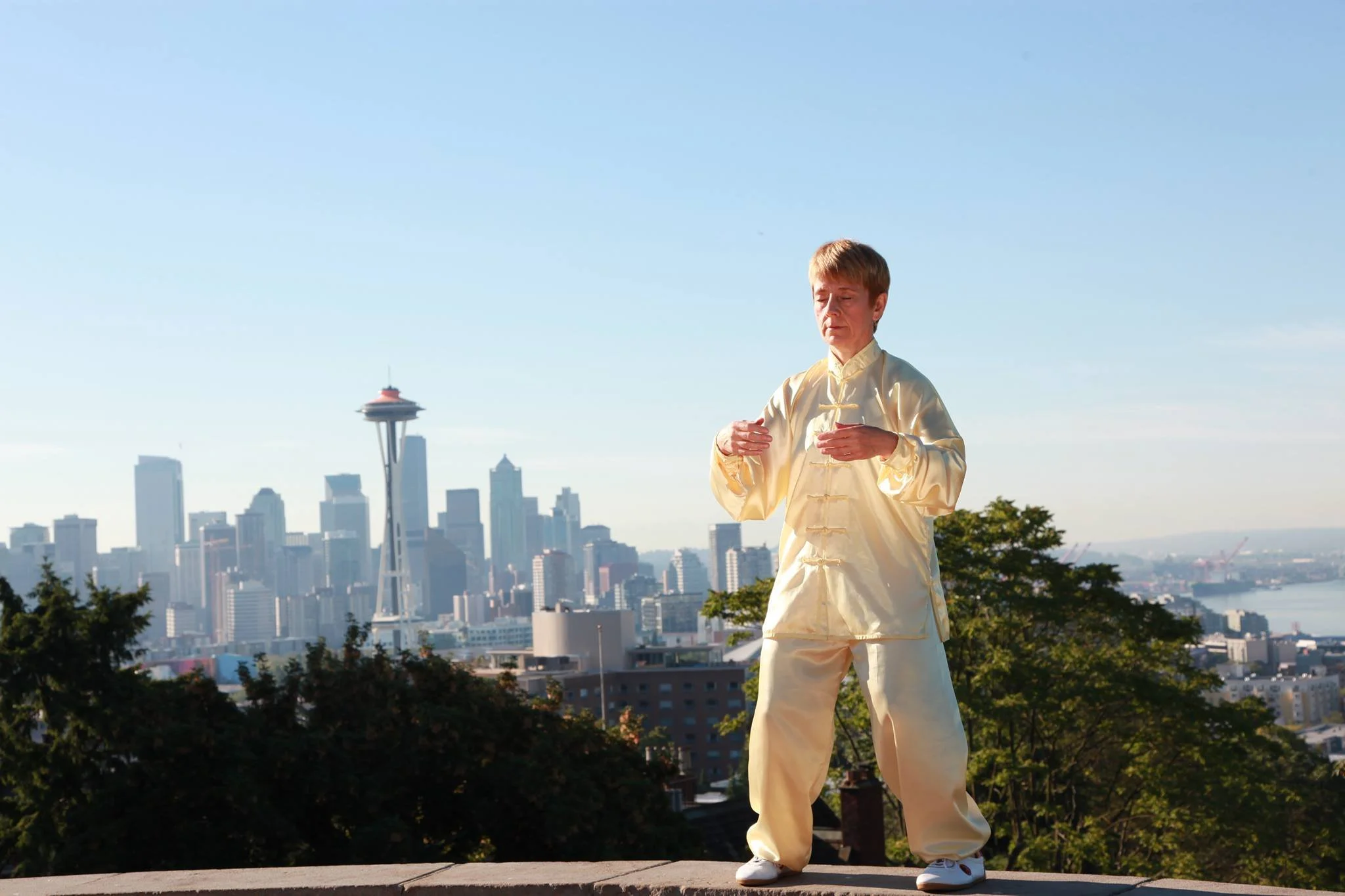
When the students who are traveling to the Chen Village soon asked what they could do to prepare for our ten-day training trip, the answer was easy: Stand. How long? 30 minutes. I was impressed at how seriously each took this advice. Within a month many students were reporting back to me their experiences. Based on what they shared, they were having exactly the experience I was hoping for: deep, curious and mixed. Of course, I’m not going to ask students to do something I’m not going to do, so I also upped my Standing game. With all of us focusing thusly, the whole school’s Standing has taken a significant leap, with many non-China goer’s also sharing that they find the whole process interesting, beneficial and invigorating.
The first time I encountered Standing Meditation was in my early Qigong days. I had already had ten years of seated meditation practice during my Judo and Karate tenure and had begun Aikido, also with a seated practice. Judo, Aikido, Shotokan Karate have a big Zen influence so seated meditation practice is integral and I embraced it. Legs folded under you, “seiza,” arms straight, hands on thighs, erect posture. Quiet mind, rhythmic breathing. The fundamental notion here came from the Samurai culture; one must oneself have a clear heart/mind to see the opponent clearly. As one goes deeper, one understands the opponent is not the “other” but one’s own mind.
Standing in Qigong was a revelation to me. Perhaps the years under my Judo belt set me up for it, but in Standing I became aware of my body in new ways. Streaming sensations, heat, deep interior spaces the movement within them. Standing allowed me to feel my root more deeply, and my center. I began to relax my muscles in ways that had nothing to do with stretch or massage - I didn’t really know what to make of it, but I loved it.
Standing or Standing on Pole as it is often referred to, is rooted in early Taoist practice. The key focus is to intentionally connect with nature. Breathing in, Standing in ways that are balanced and relaxed we gain the capacity to “exchange qi with the universe” as many say. Correcting tension, quieting mental gymnastics, adjusting postural deviations and bringing balance to the mind help us out. It began as a health practice. Health through connection to Nature and all that is available there for us to avail ourselves to.
During that time, I was severely injured in a terrifying car accident. This developing capacity to feel my interior body really helped me. I couldn’t drive or walk so friends would pick me up and take me to class. I couldn’t move much, I was quite scared, but if I focused not on the pain and trauma, but on the library of internal flow sensations available to me, I was ok and could even Stand a little.
As I began to Stand more and continued into Tai Chi, one of my teachers suggested I Stand for one hour. “You are becoming a teacher, you have to.” The good student that I am, I did. And was miserable after about 15 minutes! My back hurt, my hips tightened up. My mind! Oh my mind. Get me out of here. But, I stayed with it, trusting the process. I won’t say it happened over night, but over time my body did begin to release deeper holding and tension patterns.
My Standing practice continued to serve me in so many ways. Another time I had a very strange immune crash. No one could quite figure out the cause of my swollen joints and deep fatigue. After embracing being a lab rat at the UW, I was diagnosed with “polymigrating rheumatoid arthritis.” Later my acupuncturist thought it might have been caused by a “stored pathogen” from strep. I was quite ill for months and it took years to completely heal. Many of my students at that time remember I had to teach from a chair because I couldn’t bend my knee. In fact, this is when I first hosted Chen Xiao Xing. I will never forget his kindness, correcting me from a chair. There was not much Standing during that time, but there was a great deal of meditation, accessing all the internal sensations I had gained through the years. And I did heal, using the process as one of the valued tools.
Standing is not, as many people believe, an act of simple grit it out endurance. Standing is a very active, pragmatic process: Stand hips width apart, relax hip joints, open the belly, sit back into the rump, let go of the lower back, soften the chest, draw the head back, level the eyes. Lift the head top, feel your feet. Breathe. That’s where it starts. Then, we go about feeling the contractions in our muscle tendon structure, breathing, mind. The practice, while remaining still is to begin to release them. It’s not a one and done. We do this repeatedly, feeling a deeper connect to the earth, the sky, nature itself. The body begins to trust itself again. The quiet mind arrives. It leaves quickly too, but even if it visits now and again, it’s enough.
I remember one time a student came to Chen Xiao Wang for a private lesson. He wanted the Grandmaster to correct his entire Laojia Yilu – 75 movements – in the allotted hour. Chen Xiao Wang asked the student to Stand. He corrected the student many times throughout that hour. I saw it all as CXW asked me to Stand as well. The hour passed. The student never showed Grandmaster his form. He left very angry. CXW said to me later, “if you can’t do it Standing, how do you expect to do it moving?”
I am not a particularly quiet and still person by nature. Anxiety drives me more than I like to admit, but through Standing I have learned to uncouple a bit from it. My zippy nature has its benefits certainly, but also its issues. As I age, I see ever more clearly that conserving my energy is crucial. Once again, Standing is a fierce ally.
Humans have been detectives for a quiet mind and a flowing heart for millennium. We are attracted to beautiful movement with quiet at its core. We want to be at ease. Happy. Content. So much threatens that all the time. We are offered more ways of choosing tension and emotional upheaval than we are offered ways of ease. What if we simply stood, relaxed our hips and breathed?
When I suggested that my students practice 30 minutes of Standing in preparation, it is because I wanted them to have the physical endurance to do that during their training. They will be doing it 2-3x a day. I knew they could do it physically, but I wanted them to understand their mind within this process, to encounter themselves more deeply as preparation for encountering the form more deeply.
For me, intentionally upping my Standing practice in preparation for my trip has been just great. As those who know me know I am very competitive with myself. If 30 minutes is the goal, I’m going for 31! It’s also been a relief. There has been so much “to do” it’s great to do nothing for 31 minutes. I can also readily see how my anxiety shows up (will my practice be good enough?) and my fears (what if my teacher ignores me?) Standing reminds me they are just anxieties and fears and have no bearing on reality. The truth is I have no idea what the experience will bring. I’m open to it! Most importantly I know I’ll be able to Stand through it all.
“If the mind is quiet, all you hear are the birds singing, if the mind is busy, all you hear is squawk, squawk, squawk.”